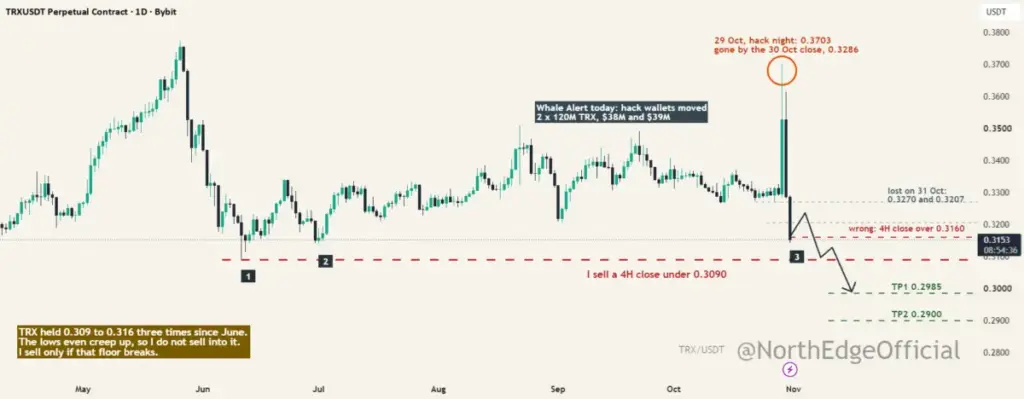
Tron’s native token, TRX, is currently navigating a precarious technical landscape following a tumultuous period defined by tight consolidation, security breaches, and shifting macro momentum across the broader cryptocurrency market. For a prolonged stretch of ten trading days, TRX maintained a relatively stable trading range, fluctuating narrowly between 0.327 and 0.333. However, this period of equilibrium was violently disrupted on the night of the high-profile Binance security breach, an event that sent shockwaves through the order books and triggered volatile price action.
During the chaos surrounding the Binance hack, TRX experienced a sharp, temporary spike, surging to 0.37 before aggressive profit-taking and market stabilization efforts brought it back down. By the time the subsequent daily candle closed, the token had retreated to 0.329, seemingly absorbing the shock. Yet, the underlying market dynamics had fundamentally shifted. Today, the token officially lost its established range, a development that has amplified anxiety among market participants. Compounding these technical fears, blockchain tracking service Whale Alert flagged two massive transactions originating directly from the wallets linked to the recent hack. Each transfer moved a staggering 120 million TRX tokens, valued at approximately $38 million and $39 million respectively.
While on-chain analysts note that these enormous sums of capital have merely been relocated rather than immediately dumped onto spot exchanges, the sheer volume of tainted supply now sitting in motion has unnerved the trading community. The presence of such a large overhang of potentially liquidatable tokens creates an invisible ceiling on sentiment, leaving many traders reluctant to commit fresh capital to the long side. This massive movement of funds has injected a palpable sense of caution into the market, overshadowing what would otherwise be a routine technical correction.
Despite the ominous shadow cast by the whale movements and the breakdown of the recent range, proponents of a bullish continuation point to a persistent historical pattern that has repeatedly saved the asset from deeper freefalls. A closer examination of the chart reveals a resilient demand zone. TRX has successfully defended the 0.309 to 0.316 price band on three separate occasions since June. Even more encouraging for proponents of an eventual recovery is the structural behavior of the lows, which have steadily crept upward over the past several months, demonstrating underlying accumulation beneath the surface noise.
This multi-month structural resilience forms the bedrock of the bull case, explaining why many market participants refuse to panic-sell into the current localized weakness. However, the immediate headwinds are difficult to ignore. The crucial swing low established on September 2, which sat at 0.3207, has now been decisively breached and lost. Compounding this bearish technical picture, the broader cryptocurrency benchmark, Bitcoin, is currently trading below its 4-hour 200-period moving average, signaling a lack of supportive macro momentum that could otherwise rescue altcoins from localized selling pressure.
Given the deteriorating technical structure and the looming threat of the hacked funds, traders are drawing distinct lines in the sand to manage their exposure. The prevailing bearish strategy centers on an entry condition triggered by a confirmed 4-hour candle close falling beneath the 0.3090 support threshold. Such a breakdown would invalidate the multi-month ascending low structure and likely accelerate selling velocity.
Should this breakdown materialize, downside projections point toward clear targets. The initial objective sits at 0.2985, with a secondary, deeper target resting at 0.2900. Market analysts note that minor intermediate support around 0.3030 could temporarily stall downward momentum, but it is unlikely to halt a determined bearish wave. Conversely, the invalidation point—the price level that proves the bearish thesis wrong—is defined as a 4-hour close back above 0.3160 following any initial breakdown attempt. Reclaiming this zone would signal a failed breakout to the downside and trap premature short sellers.
Risk management parameters for this potential trade setup have been tightly defined by market participants, featuring a stop-loss placed approximately 2.3% away from the entry threshold, contrasted against a first take-profit target offering a 3.4% gain and a second take-profit target yielding 6.1%. Yet, executing trades in the current environment requires navigating significant binary event risks.
Market observers note that a potential relief bounce could materialize when Binance officially reopens its platform withdrawals on Sunday. Such a development frequently triggers a short squeeze as sidelined liquidity rushes back in and trapped positions are hastily unwound. Facing the prospect of sudden, algorithmically driven squeeze action around the weekend reopening, many seasoned traders choose to step aside entirely rather than force an entry. As the market weighs the implications of displaced whale funds against historical support levels, the overarching question remains whether to initiate short positions on TRX at current levels or patiently wait for a definitive structural break.
Disclaimer
The information and publications are not meant to be, and do not constitute, financial, investment, trading, or other types of advice or recommendations supplied or endorsed by TradingView. Read more in the Terms of Use.
 Crypto Investing & Trading
 Crypto Investing & Trading
 Crypto Investing & Trading