The digital infrastructure sector has officially outgrown its traditional boundaries. At the Caesars Forum in Las Vegas, Yotta 2026 drew more than 6,500 industry leaders, including upwards of 600 chief executive officers, over 300 speakers, and more than 350 exhibitors spread across 180 distinct sessions. Having previously outgrown the MGM Grand, the conference has effectively doubled in size once again, serving as a barometer for a
rapidly maturing market where physical compute, power generation, and institutional capital have become inextricably linked.
Among the prominent industry participants on the ground was Luxor Technology Corporation. Chief Executive Officer Nick Hansen and Chief Operating Officer Ethan Vera spent three intensive days navigating conversations centered on powered shells, data center software, hardware scoping, and large-scale capital financing. Amidst the bustling exhibition floor and executive meetings, Ethan Vera also appeared on Blockspace Live from the press room to discuss the evolving landscape of compute derivatives and Luxor’s expanding artificial intelligence product suite.
While mainstream coverage of summits like Yotta often remains fixated on silicon advancements and raw megawatt capacity, the operational reality for those who build, finance, and run physical compute infrastructure points to a much deeper transformation. The fundamental language governing the sector is shifting, moving away from speculative hype and toward structured commodity markets.
The Language of Compute is Changing
Opening the conference, Yotta co-founder George Rockett framed the event around a convergence that has quietly reshaped the industry: the building, the power, the chip, and the capital stopped being separate conversations a long time ago. The conference agenda heavily reflected this reality, featuring dedicated tracks on financing massive buildouts, grid interconnection logistics, graphics processing unit economics, zoning permitting, and public acceptance.

What remains relatively new, however, is the technical vocabulary being deployed across boardrooms and exhibition halls. Terms like offtake, index, forward curve, residual value, and basis risk have migrated directly from traditional commodity markets to become the default lexicon for discussing artificial intelligence hardware. Where a buyer three years ago might have simply asked how many H100 units they could acquire, today’s infrastructure investors routinely inquire about asset yields, utilization risk allocation, and what the residual value of the hardware will be worth five years down the line.
Bitcoin miners are entirely familiar with this trajectory. The application-specific compute of SHA-256 hashrate evolved over several years from a niche technical specification into a transparently priced, hedgeable commodity. That evolution required specific, calculated steps: establishing a public reference price via the hashprice index in 2020, moving toward over-the-counter forwards by 2022, and ultimately clearing CFTC-approved listed futures by 2024. General-purpose compute for artificial intelligence and high-performance computing is currently navigating somewhere between the first and second steps of that exact playbook.
Compute Derivatives Are Stuck on Index Construction, Not Demand
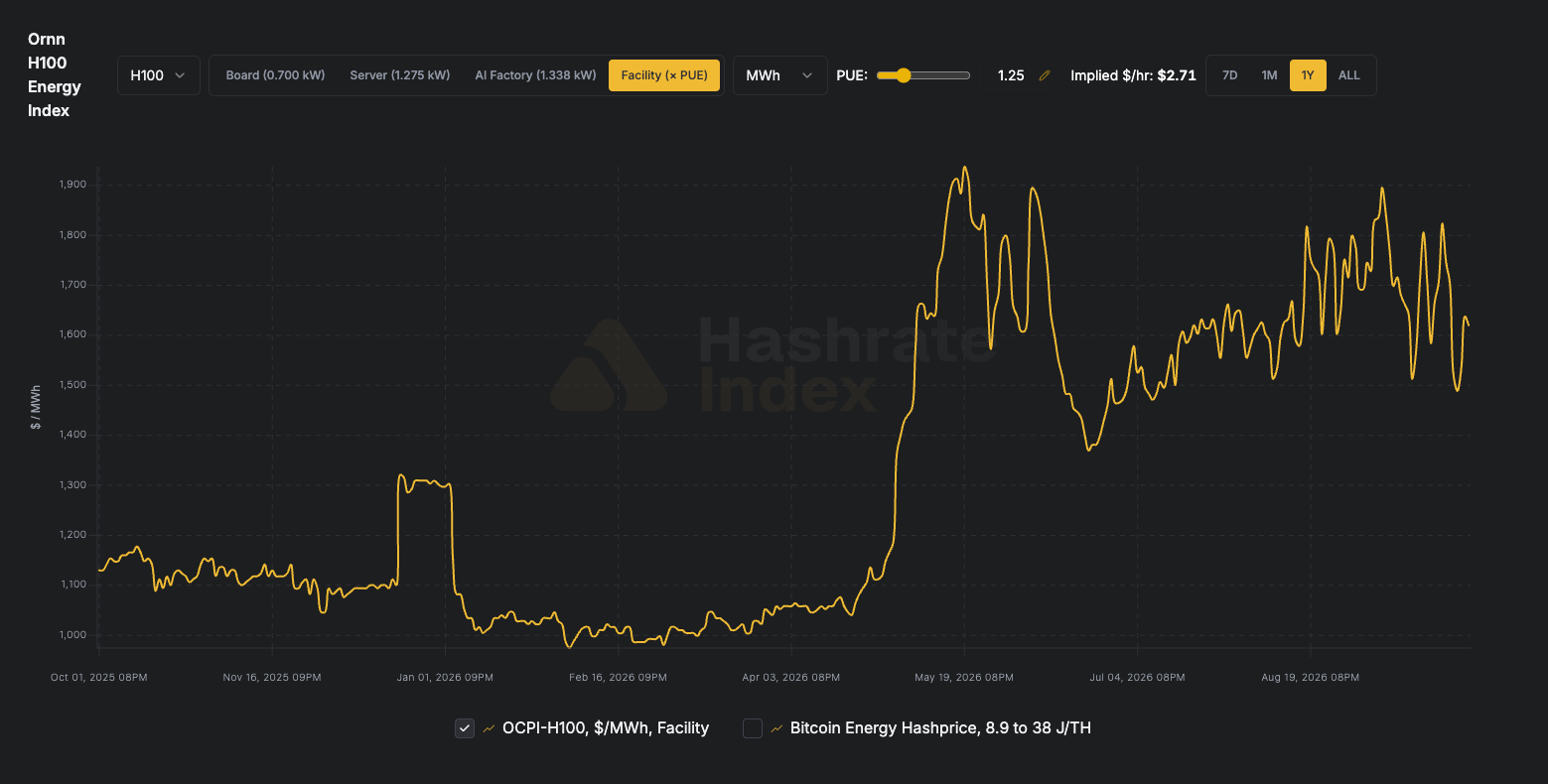
Despite surging interest, cash-settled compute futures initiatives have faced structural headwinds. Three major initiatives are currently in motion, including the CME Group working with Silicon Data’s H100 and B200 rental indexes, the Intercontinental Exchange utilizing Ornn’s Compute Price Index, and Nodal Exchange developing Compute Desk benchmarks. None have officially launched. Notably, the Commodity Futures Trading Commission extended its review of the CME contracts by 45 days, pushing a targeted October listing into November while regulators examine complex questions regarding the potential manipulability of GPU rental prices in a market heavily reliant on brokers, cloud platforms, and bilateral negotiations.
According to Luxor COO Ethan Vera, the primary bottleneck delaying these financial products is index construction rather than a lack of institutional appetite. Existing indexes are predominantly built on on-demand bare metal rentals, which represent only a thin slice of how compute actually trades in the real world. As Vera noted during the event, most of the industry transacts via long-term bare metal rentals, while short-term contracts are frequently managed through token generation, meaning current public indexes are observing a very small fraction of the broader market.
This data challenge is fundamentally structural. Long-term corporate contracts remain strictly proprietary, and the various marketplaces holding pricing data only share information when there is a clear commercial incentive to do so. While index providers have managed to secure partnerships with some platforms, they have not yet cleared the comprehensive thresholds required for standard CFTC exchange listings.

Nevertheless, the broader compute derivatives market is already functioning at scale through physically delivered contracts. A three-to-five-year bare metal agreement established between a neocloud provider and a frontier artificial intelligence laboratory functions essentially as a physically delivered forward contract. This mirrors the over-the-counter-first sequence observed in the SHA-256 hashrate forward market, highlighting the exact market gap that specialized desks are actively working to bridge.
Token Margins Are Thin While Compute Revenue Remains Bankable
Across nearly every operator conversation at Yotta, participants arrived at the same fundamental conclusion: while everyone agrees that the ultimate product is tokens, almost nobody can adequately explain how to underwrite one. Selling tokens increasingly resembles a low-margin commodity business rather than traditional software, driven by heavy capital expenditures and fierce market competition.
Because operating margins remain thin, token prices cannot continue falling indefinitely, suggesting that open-weights token prices will eventually establish a firm market floor. Providers that own their servers and operate optimized endpoints assume genuine financial risk and cannot sustain operations below a double-digit gross margin over the long term. Consequently, frontier model pricing has already shown signs of stabilizing, with open-weights pricing expected to follow suit.
Underlying hardware economics continue to drive capital risk upward. Current medians on the AI Hardware Price Index position an eight-GPU B300 node at roughly $544,280, translating to $68,035 per GPU, compared to approximately $40,555 per GPU for a new H100 node. While each successive hardware generation performs more work per dollar, its higher upfront cost per GPU means providers have significantly more capital at risk on every node deployed. That capital must generate a steady return regardless of short-term token price fluctuations.
For mining operators looking to diversify, this dynamic highlights a crucial distinction: the most dependable revenue in the stack does not reside with those selling tokens, but rather one layer down with those providing raw compute. Laboratories either rent capacity or purchase hardware directly, committing hundreds of millions of dollars upfront. That foundational commitment forms reliable revenue for the compute provider, contracted well in advance and largely indifferent to the shifting popularity of any single software model.

Financing vehicles are mobilizing rapidly to support this infrastructure buildout. Major financial institutions, including Apollo, BlackRock, Blackstone, Brookfield, Goldman Sachs, and KKR, have signed memorandums of understanding with NVIDIA to construct compute financing platforms targeting more than $500 billion in third-party capital, utilizing the physical GPUs as direct collateral. Structuring a GPU cluster financing deal similarly to a toll road or power plant, however, requires predictable revenue streams—precisely what thin and volatile token margins often make difficult to prove.
To address this, market participants are exploring contractual structures that guarantee neocloud providers a minimum level of revenue per node while splitting profits above that threshold. Operators retain the upside if compute prices rise while maintaining a revenue floor acceptable to institutional lenders. This risk-mitigation logic is immediately familiar to Bitcoin miners who rely on hashprice forwards to determine the minimum revenue per unit of capacity required to make an operation financeable.
Modular Data Centers Move From Concept to Reality
Physical signals of industry maturation were clearly visible outside the conference halls. The newly established Campus Exhibit featured modular data centers, microgrid generators, and closed-loop liquid cooling systems constructed at full working scale, allowing attendees to walk directly inside operational units. Dozens of providers showcased modular products, with a significant share now backed by verifiable production deployments rather than theoretical digital renders.
This shift is primarily driven by project sequencing. While grid interconnection, permitting, and long-lead electrical equipment dictate overall project schedules, prefabricated modular pods can dramatically compress timelines under an operator’s direct control. The trade-off is familiar to the mining sector: factory-built capacity requires higher upfront capital per megawatt and limits custom engineering, but it saves crucial months in deployment time.
The existing market for Bitcoin mining containers serves as a direct conceptual ancestor to these modern modular units, though with stark differences in density and thermal management. Traditional mining containers primarily move air across ASICs, whereas modern artificial intelligence pods represent sophisticated liquid-cooled systems built around high-capacity racks equipped with coolant distribution units and advanced leak detection mechanisms.
Procurement standards have likewise evolved. While white-label markets present varying degrees of quality control, established operators increasingly demand enterprise-grade hardware backed by comprehensive multi-year warranties and rapid on-site support to ensure multi-million-dollar clusters remain operational.
International Interest Rises as Domestic Permitting Tightens
Domestic constraints within the United States are no longer exclusively electrical. State-level policies, such as New York’s enactment of a statewide moratorium on new hyperscale data centers, have paused discretionary environmental permitting for facilities exceeding 50 megawatts. Lawmakers across roughly fifteen states have similarly considered restrictive measures or moratoriums, adding to hundreds of local zoning limitations. When combined with regional demand forecasts that consistently outrun generation and transmission timelines, navigating multi-year power queues alongside tightening regulatory hurdles presents a risk profile that challenges traditional investment committees.
In response, capital is increasingly flowing toward international emerging markets. A notable shift is occurring on the financing side, where lenders and offtakers who previously avoided emerging-market compute are now willing to underwrite projects backed by creditworthy offtake agreements. Quality contracting allows jurisdiction to be treated as a pricing input rather than an outright disqualifier.
This dynamic mirrors the stranded-power arbitrage that previously redirected hashrate into regions like Paraguay, Brazil, Ethiopia, and Oman, though with tighter latency constraints and stricter requirements for political and economic stability. Mining operators who have successfully built and operated infrastructure in those international jurisdictions maintain valuable site control, established grid relationships, and local operating experience that incoming artificial intelligence capital is actively seeking to leverage.
Ultimately, artificial intelligence compute is rapidly cementing its status as an established commodity complete with transparent pricing curves and functioning credit markets. For digital infrastructure operators navigating the intersection of power, hardware, and capital, the overarching lesson from Las Vegas is clear: the most durable and secure position in the stack remains the one closest to the power source.
 Cryptocurrency Mining
 Cryptocurrency Mining
 Cryptocurrency Mining