The cryptocurrency market is navigating a complex landscape of technological headwinds, shifting macroeconomic sentiments, and evolving institutional products. Recent data analytics have brought long-term technical vulnerabilities into sharp focus, while spot prices for major digital assets experience notable volatility. From alarming structural risk assessments concerning quantum computing threats to institutional treasury accumulation and regulatory progress for exchange-traded funds, market participants continue to balance emerging risks with strategic opportunities.
Nearly 10% of Bitcoin Supply Is ‘Structurally Unsafe’ From Quantum Breakthrough, Glassnode Warns
Nearly 10% of the total Bitcoin supply is considered "structurally unsafe" from a potential quantum computing breakthrough because their specific output types reveal the public key by design, regardless of how address management practices are handled. This insight comes from recent metrics published by the digital asset data analytics platform Glassnode.
Totaling approximately 1.92 million Bitcoin (BTC), this vulnerable cohort comprises several distinct categories of coins. These include early Satoshi-era Pay-to-Public-Key (P2PK) outputs, legacy multi-signature structures such as Pay-to-Multisig (P2MS), and modern Pay-to-Taproot (P2TR) outputs. According to a post shared by Glassnode on the social media platform X, all of these architectures expose the public key or a public key-equivalent directly by design.
A breakdown of the numbers reveals that coins associated directly with Bitcoin creator Satoshi Nakamoto account for about 1.1 million, or roughly 5.5% of the vulnerable supply. An additional 620,000 Satoshi-era coins make up another 3.1% of the total supply, while approximately 200,000 coins, or 1%, are currently held within Taproot addresses. While the realization of a cryptographically relevant quantum computer capable of cracking these encryption standards remains a theoretical milestone in the future, the structural design of these legacy and modern outputs highlights ongoing cryptographic challenges facing the world’s oldest and largest blockchain network.

Ethereum Traders Say Bears ‘In Control’ After ETH Price Drop to $2K
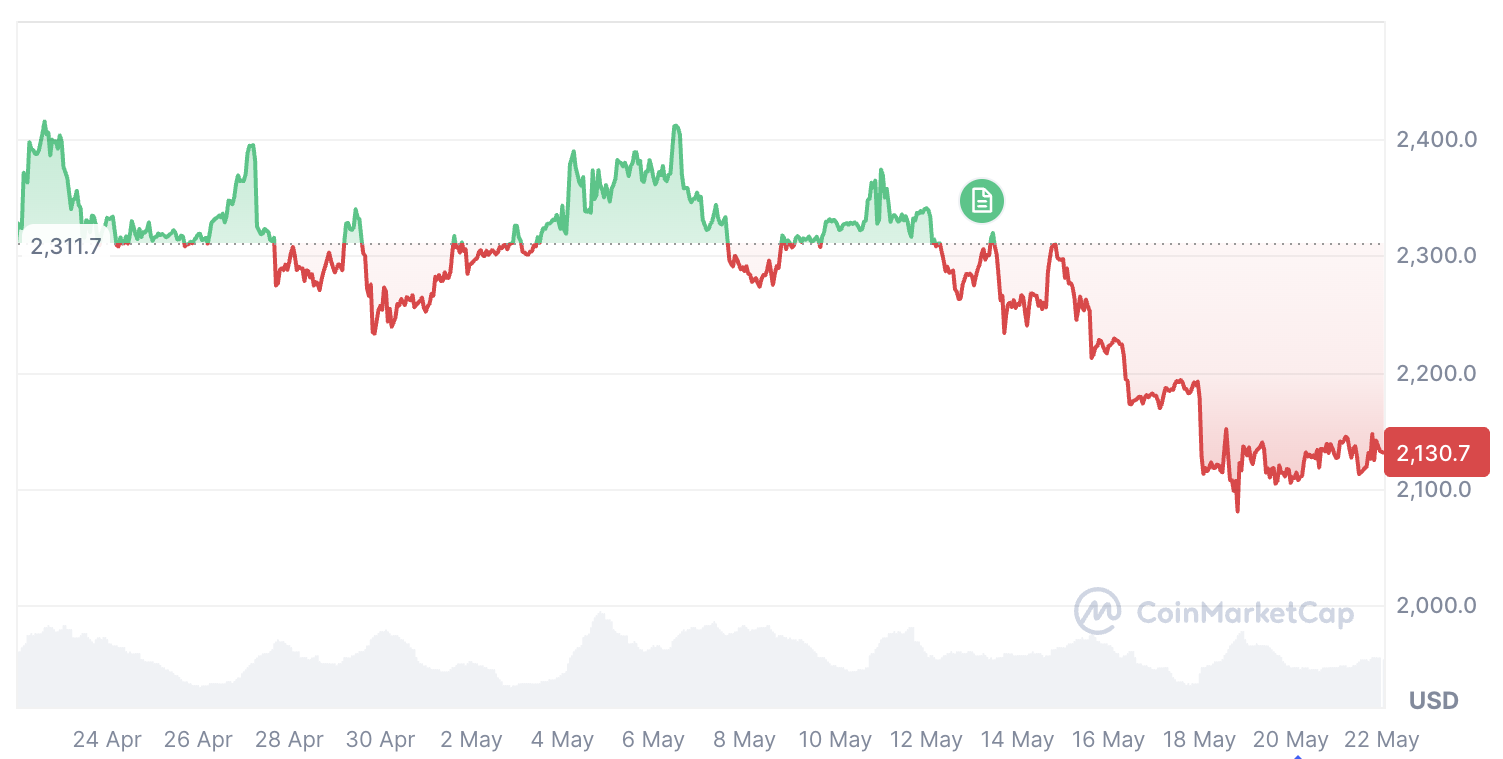
Shifting focus to the altcoin sector, Ether (ETH) experienced a sharp downward correction after failing to maintain momentum near the $2,400 resistance level earlier in the week. The asset plummeted as low as $2,100, signaling to market observers that bearish forces have firmly retaken control of the short-term price trend.
According to technical data from TradingView, ETH was recently changing hands around $2,131, marking a decline of roughly 12% below its local high of $2,420, which was registered on May 6. Downward pressure intensified over the weekend when the ETH/USD trading pair touched $2,090 on the Bitstamp exchange, representing its lowest valuation since April 17.
This resurgence of bearish sentiment across the Ether market is further corroborated by order book dynamics on Binance, the world’s largest cryptocurrency exchange by trading volume. Key metrics from the platform indicate that aggressive sellers are increasingly dominating trading volumes. Specifically, the Binance taker buy volume—a metric tracking the total dollar amount of aggressive sell orders placed by traders utilizing futures contracts—surged past $1.1 billion within a single hour on Sunday as ETH slipped toward the $2,100 threshold. Across a broader 30-day window, Ethereum remains down by approximately 8.44%, according to CoinMarketCap data.
Ether Pullback Was ‘Attractive Opportunity’ for 71,672 ETH Buy, Says Bitmine’s Tom Lee
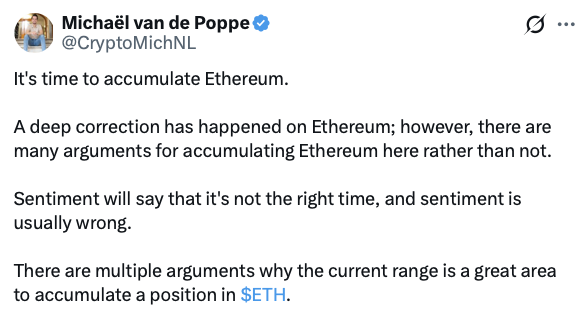
Despite the prevailing market turbulence and falling prices, large institutional treasury entities view the recent correction as a strategic accumulation window. Tom Lee, chairman of Bitmine Immersion Technologies, announced that the crypto treasury firm capitalized on the recent dip below $2,200 to significantly expand its digital asset holdings.
"Over the past week, we acquired 71,672 ETH. We view the recent pullback of ETH to below $2,200 as an attractive opportunity. Bitmine is expected to reach the alchemy of 5% sometime in 2026," Lee stated.
Bitmine operates as the preeminent Ether treasury company, following a business model characterized by steady, recurring token accumulation during market downturns. This strategy bears strong similarities to the corporate treasury playbook utilized by Michael Saylor’s Bitcoin-focused firm, Strategy. By aggressively building its reserves during periods of forced liquidation and market pessimism, Bitmine continues to solidify its footprint in the digital asset ecosystem.
XRP Price May Explode to $15 Amid ‘Quiet Accumulation,’ Analyst Claims
While Ethereum faces short-term selling pressure, some analysts are projecting massive upside potential for other top-tier altcoins. According to market analyst Crypto Patel, XRP (XRP) could be gearing up for a substantial 10x to 15x price rally originating from a current "quiet accumulation" zone. Patel noted that the token’s subdued price action mirrors the calm period observed right before its major breakout in late 2024.
In a recent analysis shared on social media, Patel highlighted the $1.00 to $0.70 price band as a vital long-term accumulation corridor. He argued that the lack of retail hype and muted market sentiment frequently precede significant upward movements. The analyst’s charts illustrate that XRP experienced a pullback after failing to breach the robust $3.20 to $3.50 resistance ceiling, leading prices to drift toward a favorable green demand zone that he characterizes as a massive market opportunity.
Projecting forward, Patel outlined ambitious upside targets at $5, $10, and $15. Achieving these levels would represent a 10-fold to 15-fold appreciation from the lower boundary of the accumulation range, provided XRP can replicate the structural cycle expansion it exhibited during the 2022-to-2024 period. Over the trailing 30-day period, XRP has posted a modest decline of 4.36%, keeping it range-bound while market participants await clearer macro signals.
Grayscale, VanEck Amend US Spot BNB ETF Filings, Stepping Closer to Potential Launch
On the regulatory front, institutional interest in expanding access to alternative digital assets via traditional financial vehicles continues to progress. Asset management heavyweights Grayscale and VanEck submitted amended S-1 registration statements for their respective spot BNB exchange-traded funds, pushing the asset a step closer to potential regulatory approval in the United States.
Grayscale formally submitted its second amendment, while VanEck advanced its filings by submitting its fifth amendment. S-1 registration statements represent a core component of the SEC approval pipeline for ETF issuers, containing comprehensive disclosures regarding fund structures, operational strategies, management fee schedules, and associated investment risks.
Commenting on the developments, Bloomberg ETF analyst James Seyffart noted on social media that the steady stream of amendments suggests issuers are actively responding to feedback from regulatory bodies. This ongoing dialogue raises expectations for potential product launches in the near future, which could position BNB as the next major cryptocurrency asset to secure a spot-based ETF vehicle in the United States.
 Non-Fungible Tokens (NFTs)
 Non-Fungible Tokens (NFTs)
 Non-Fungible Tokens (NFTs)