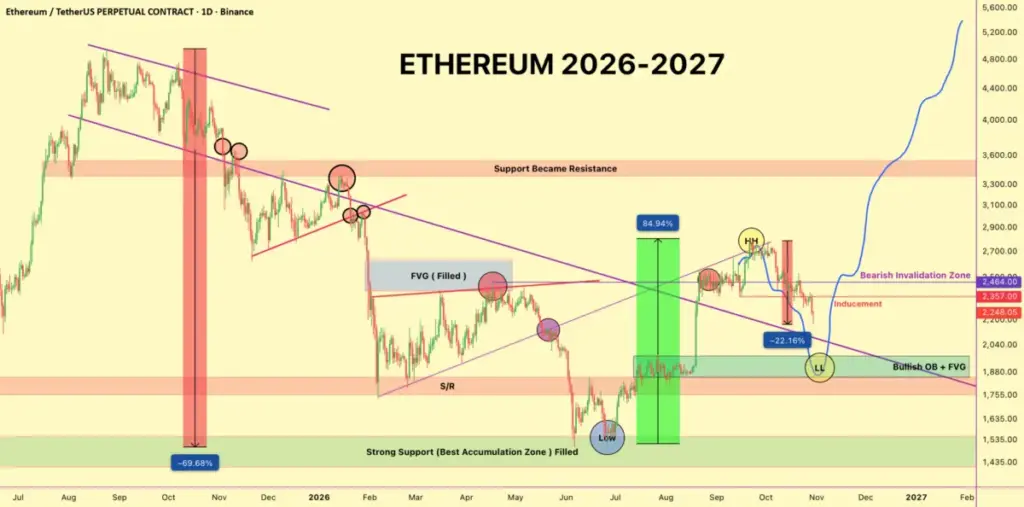
Ethereum (ETH) has experienced a sharp market correction, plunging approximately 22% from its recent local high of $2,806 as a heavily scrutinized technical warning validates itself across the crypto asset landscape. The recent downside movement follows a textbook breakdown of key market structures, validating earlier warnings that cautioned market participants against aggressively chasing long positions near local resistance levels.
The decline did not arrive without notice. Market observers who tracked the previous technical updates on Ethereum were explicitly advised that a break below critical inducement levels, combined with a confirmed higher-timeframe (HTF) candle close beneath that threshold, would inevitably open the door to accelerated selling pressure. The projected downside targets highlighted during those initial warnings pointed directly toward the $1,950 to $1,800 demand zone—a forecast that is now unfolding in real-time across spot and derivatives exchanges.
The sequence of events leading to the current correction began when Ethereum established a clear Higher Low followed by a Higher High market structure culminating around the $2,806 price mark. During this peak phase, market analysts urged caution, explicitly advising traders against initiating fresh long positions at elevated valuations and outlining the substantial downside risks looming beneath the surface. Once the higher-timeframe structure failed to hold its ground, the bearish scenario shifted from a theoretical risk to an active market reality. ETH/USDT has since slid significantly, shedding roughly 22% of its value from that $2,806 pivot point and testing the patience of leveraged retail and institutional traders alike.
Despite the pronounced near-term correction, broader market perspectives remain nuanced, balancing immediate technical pain with a broader macro outlook. In the short term, market participants are closely monitoring the $1,950 to $1,800 downside zone to see how price action responds and whether buyers will step in to establish a durable local bottom. This region represents a critical technical hurdle where historical liquidity and order book depth could potentially absorb remaining selling pressure and stabilize the asset.
At the same time, longer-term convictions regarding Ethereum’s fundamental trajectory remain firmly intact among seasoned observers. Even with a steep 22% drawdown from local highs, multi-year outlooks continue to project a heavily bullish long-term horizon. Within the context of larger market cycles, well-regarded analyses maintain that Ethereum possesses the underlying network adoption, utility, and structural market demand required to reach ambitious cycle targets in the $10,000 to $15,000 range over the coming years.
This divergence between short-term weakness and long-term strength underscores a fundamental principle of professional asset management and technical trading: maintaining a bullish macro bias must never translate into ignoring bearish short-term market structures. Navigating volatile cryptocurrency markets successfully requires traders to respect prevailing price action, account for active liquidity pools, and remain entirely flexible rather than emotionally attached to a single directional bias.
The unfolding correction serves as a clear reminder of why chasing momentum at established resistance zones like $2,806 carries severe risk. As Ethereum navigates its current retracement toward the targeted support levels, market participants continue to reevaluate risk parameters while keeping a watchful eye on how the asset behaves within the crucial $1,950 to $1,800 demand pocket.
 Crypto Investing & Trading
 Crypto Investing & Trading
 Crypto Investing & Trading