The market for artificial intelligence compute hardware has long operated in the shadows. Much like the early days of Bitcoin mining when application-specific integrated circuit (ASIC) hardware trading lacked unified public benchmarks, the modern market for high-performance AI chips is notoriously opaque. There are no centralized public price lists, original equipment manufacturers (OEMs) and original design manufacturers (ODMs) typically quote prices exclusively by request, and secondary markets rely heavily on private broker relationships that rarely surface publicly.
For institutional buyers, infrastructure developers, and data center operators trying to establish the fair market value of an enterprise-grade AI hardware asset—such as an 8-GPU H100 node—the lack of a standardized reference point has been a persistent challenge. To address this structural information gap, Hashrate Index has officially launched its new AI Hardware Price Index, bringing much-needed pricing visibility to the rapidly evolving artificial intelligence compute sector.
Methodology Behind the Index
While there is no formal public exchange or centralized order book for high-end GPU nodes, the market does feature dozens of specialized hardware vendors that publish asking prices across various digital channels. Hashrate Index’s new tracking mechanism systematically collects, aggregates, and analyzes this publicly available vendor pricing data to construct a reliable daily market benchmark.

Rather than attempting to track every possible hardware configuration on the market, the index focuses deliberately on a standardized, narrow system specification: a complete, air-cooled, 8-GPU NVIDIA HGX node. Liquid-cooled variants, smaller 4-GPU chassis configurations, standard DGX systems, and bare HGX baseboards are currently held out of the primary index to ensure meaningful, apples-to-apples comparisons. Furthermore, each node is priced precisely according to how the vendor configured it, meaning values are not artificially normalized to a single reference build. Because the HGX baseboard accounts for the vast majority of a system’s overall bill of materials, secondary component variations—such as choices in central processing units, system memory, and onboard storage—tend to influence the total asking price far less than the underlying graphics processing units themselves.
The mechanics of the index rely on tracking the last observed asking price for each individual listing, keeping those values active until a vendor formally reprices or removes the listing. The published daily value represents the median figure derived from every live listing recorded on that specific calendar day. The methodology deliberately avoids data interpolation and mathematical smoothing, ensuring that every data point on the chart reflects a real, posted asking price median captured at the time it was advertised.
Platform developers emphasize two critical distinctions regarding what the index represents. First, the data is strictly non-transaction-derived. The figures reflect public asks—what sellers are actively advertising—rather than closed, privately negotiated deals. Second, the index does not publish a spread-free figure. Because the active vendor panel is currently compact and the prevailing price range remains wide, publishing a single point estimate would risk introducing bias. Consequently, using the median provides a balanced view of where market expectations currently sit.
What the Data Reveals About AI Hardware Valuations
The newly released dataset offers rare quantitative insights into current market dynamics, pricing dispersions, and generational premiums within the enterprise AI infrastructure landscape.
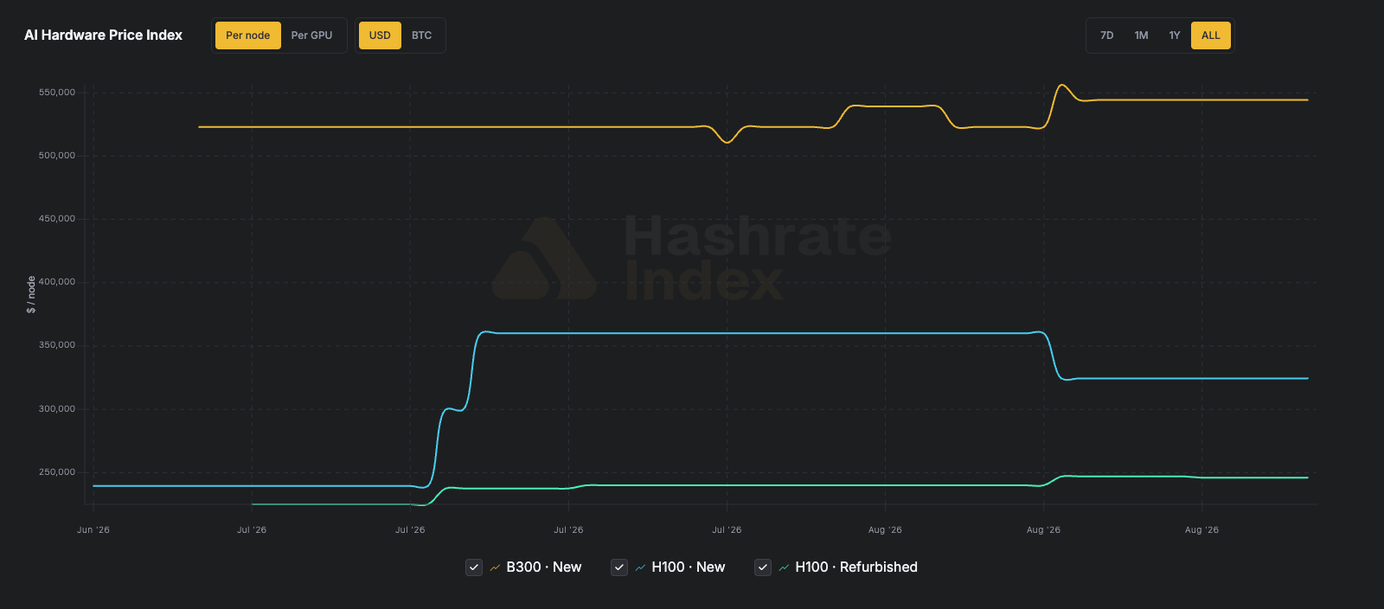
One of the most prominent takeaways from the initial data release is significant price dispersion across identical hardware tiers. For instance, air-cooled 8-GPU B300 nodes are currently advertised across a wide spectrum, ranging from $399,999 to $682,000, creating a notable 1.71x spread between the lowest and highest public asks. Similar dispersion patterns appear in the Hopper generation, where new H100 nodes demonstrate a 1.70x spread, and refurbished H100 units exhibit a 1.73x spread.
The index also establishes clear comparative metrics regarding the valuation spread between distinct hardware generations. At approximately $68,035 per individual GPU, the newer Blackwell Ultra platform commands a 1.68x premium over the standard new-node price for Hopper units, which sit at roughly $40,555 per GPU. Analysts note that this premium is relatively narrow compared to the substantial performance gap typically advertised between the two hardware generations. This narrower pricing gap is largely attributed to the continued availability of existing H100 supply alongside extended lead times for newer Blackwell B300 allocations.
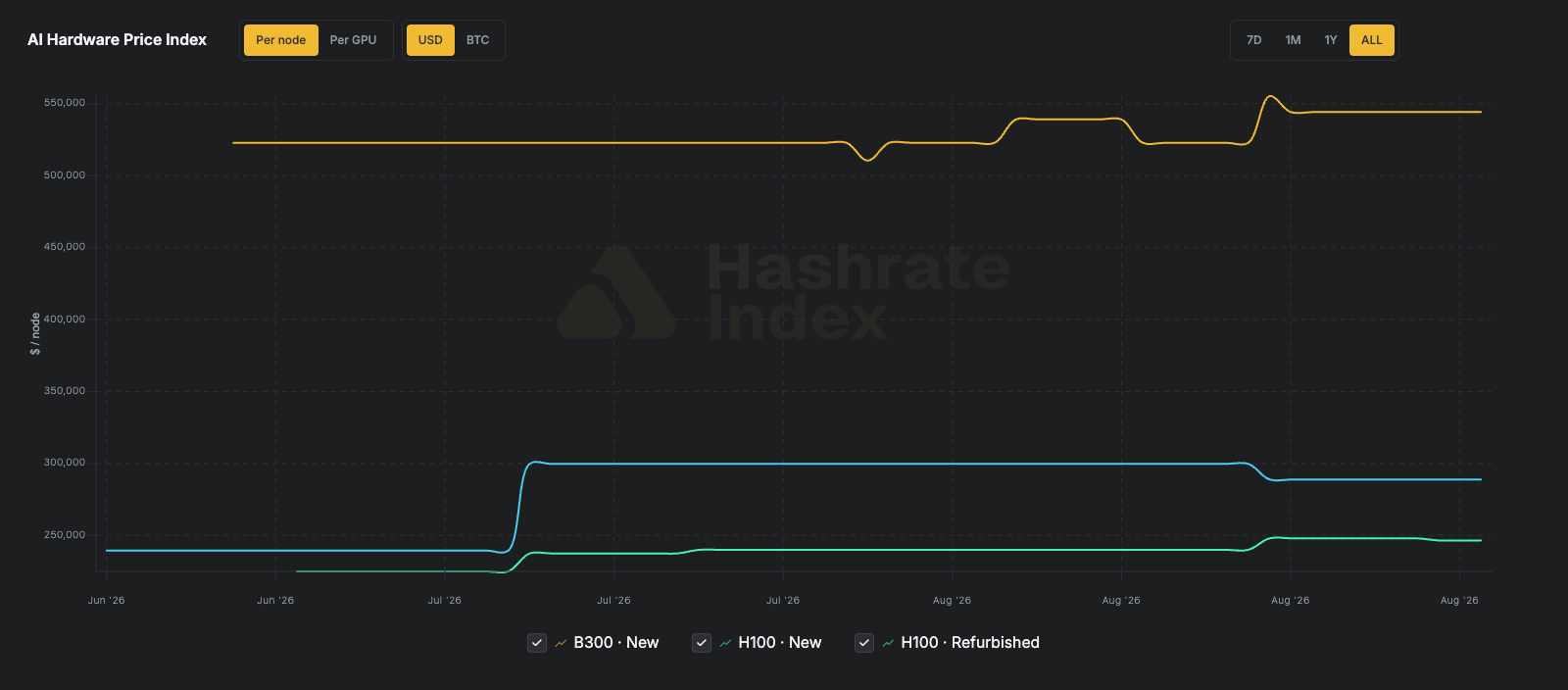
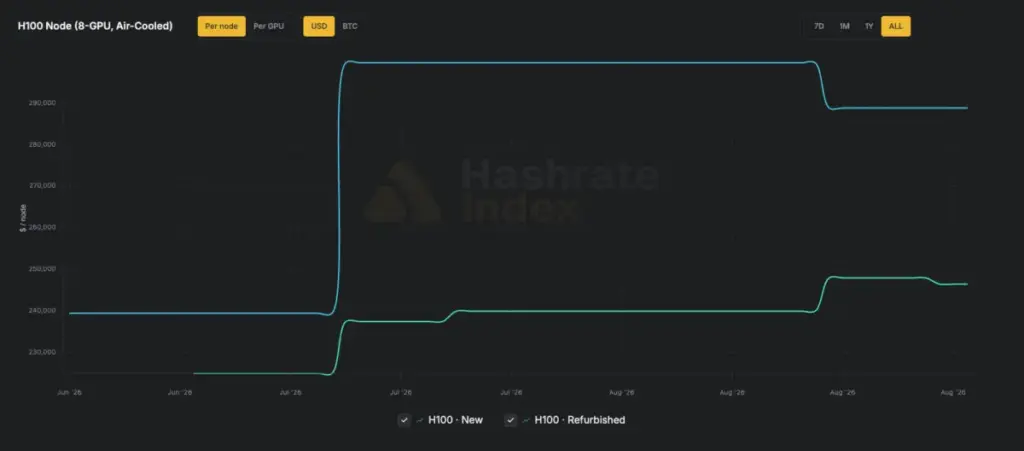
Additionally, the dataset provides empirical insight into the economic trade-offs between purchasing brand-new hardware versus acquiring certified refurbished systems. Refurbished H100 nodes currently trade at roughly 76 percent of the asking price for equivalent new-node configurations. To provide further context, a brand-new, bare HGX H100 8-GPU baseboard has been observed at public asking prices around $179,000—representing approximately 73 percent of the refurbished complete-system node median. This relationship offers market participants a clear baseline indicator of how far complete-system prices might need to drop before it becomes economically advantageous for buyers to purchase bare baseboards and assemble custom compute nodes internally.
Dedicated Individual Tracking Pages
To provide granular visibility into these hardware classes, Hashrate Index has introduced dedicated tracking pages for specific system architectures.
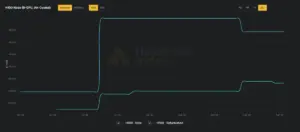
The B300 Node page tracks the air-cooled 8U Blackwell Ultra node, capturing its unique price trajectory as enterprise demand shifts toward higher-density processing units. Meanwhile, the H100 Node page displays both new and refurbished pricing series on a single, unified chart. By visualizing these two categories side-by-side, the platform allows market observers to track how the broader ecosystem values hardware depreciation, operational wear, and manufacturer warranties over time.
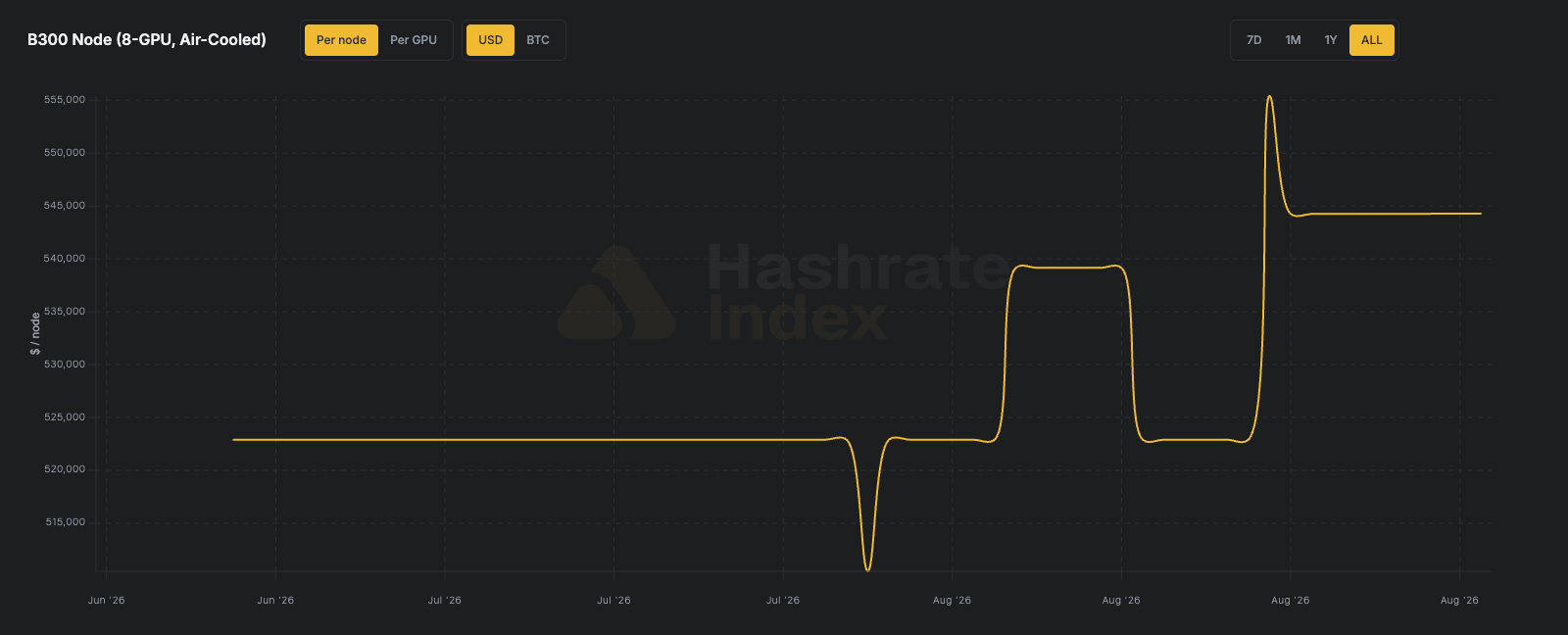
Both system pages feature versatile display toggles, allowing users to view data on a per-node or per-GPU basis, as well as switching between traditional United States Dollar (USD) valuations and Bitcoin (BTC) denominations. The per-GPU basis provides the standard metric required for cross-platform hardware comparisons, while the Bitcoin-denominated view serves organizations and data center operators that fund infrastructure acquisitions directly from digital asset mining revenues.
Expanding Compute Commodities
The introduction of the AI Hardware Price Index marks a significant expansion for Luxor Technology Corporation, the parent organization behind Hashrate Index, as it broadens its analytical scope beyond traditional Bitcoin and SHA-256 computational infrastructure. Company representatives indicate that further commodity compute metrics and datasets will be rolled out in the near future as the intersection between high-performance computing, energy markets, and digital assets continues to mature.
 Cryptocurrency Mining
 Cryptocurrency Mining
 Cryptocurrency Mining