The economics of industrial-scale compute are undergoing a seismic shift, as three distinct forms of hardware—NVIDIA’s artificial intelligence graphics processing units, specialized Zcash mining rigs, and Bitcoin Application-Specific Integrated Circuits (ASICs)—compete fiercely for the same scarce resource: electrical power. In a modern data center or mining facility, energy is the ultimate common denominator. How a facility operator allocates its megawatts dictates whether compute yields astronomical AI revenues or the rapid payback cycles characteristic of cryptocurrency mining.
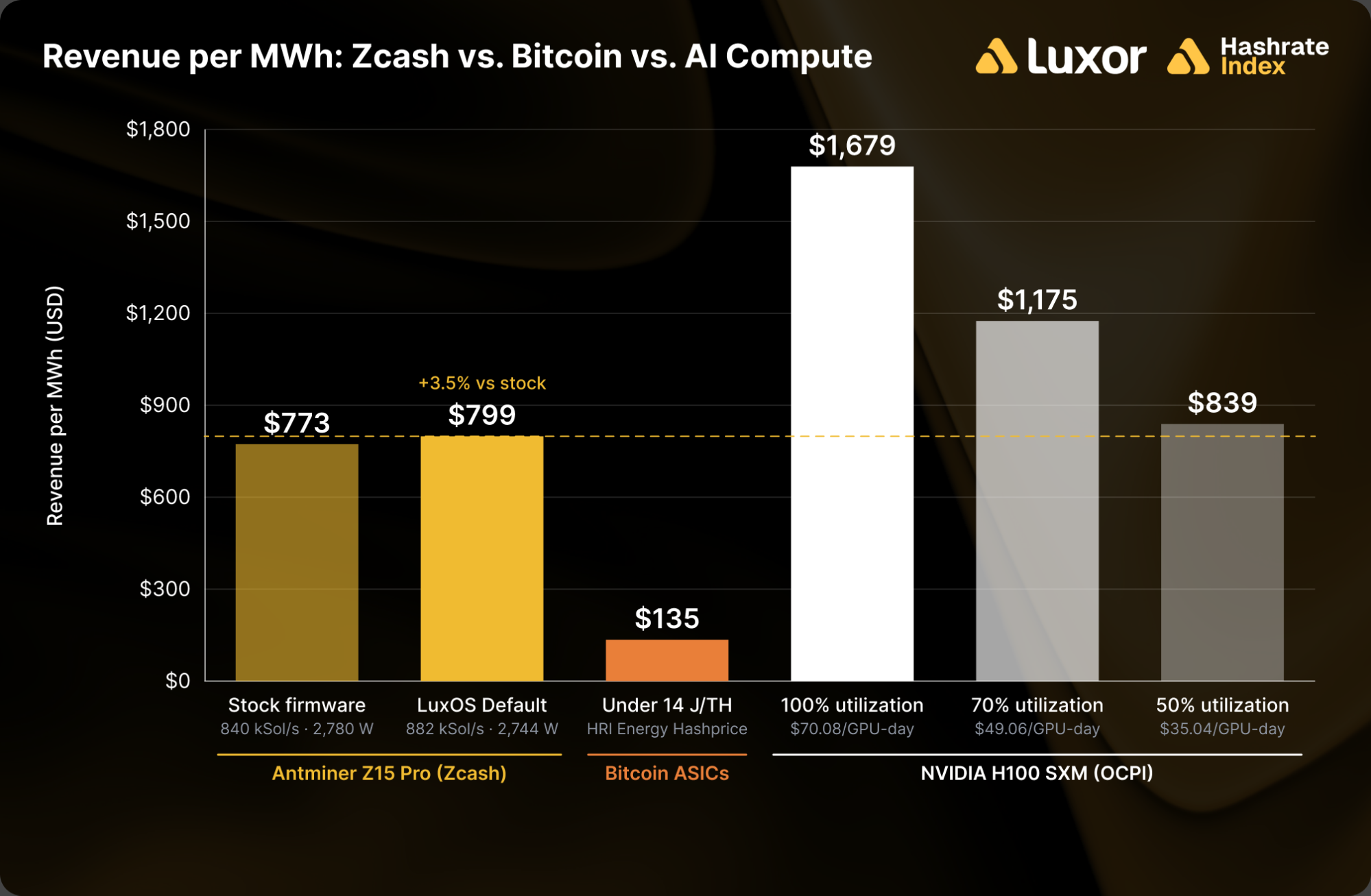
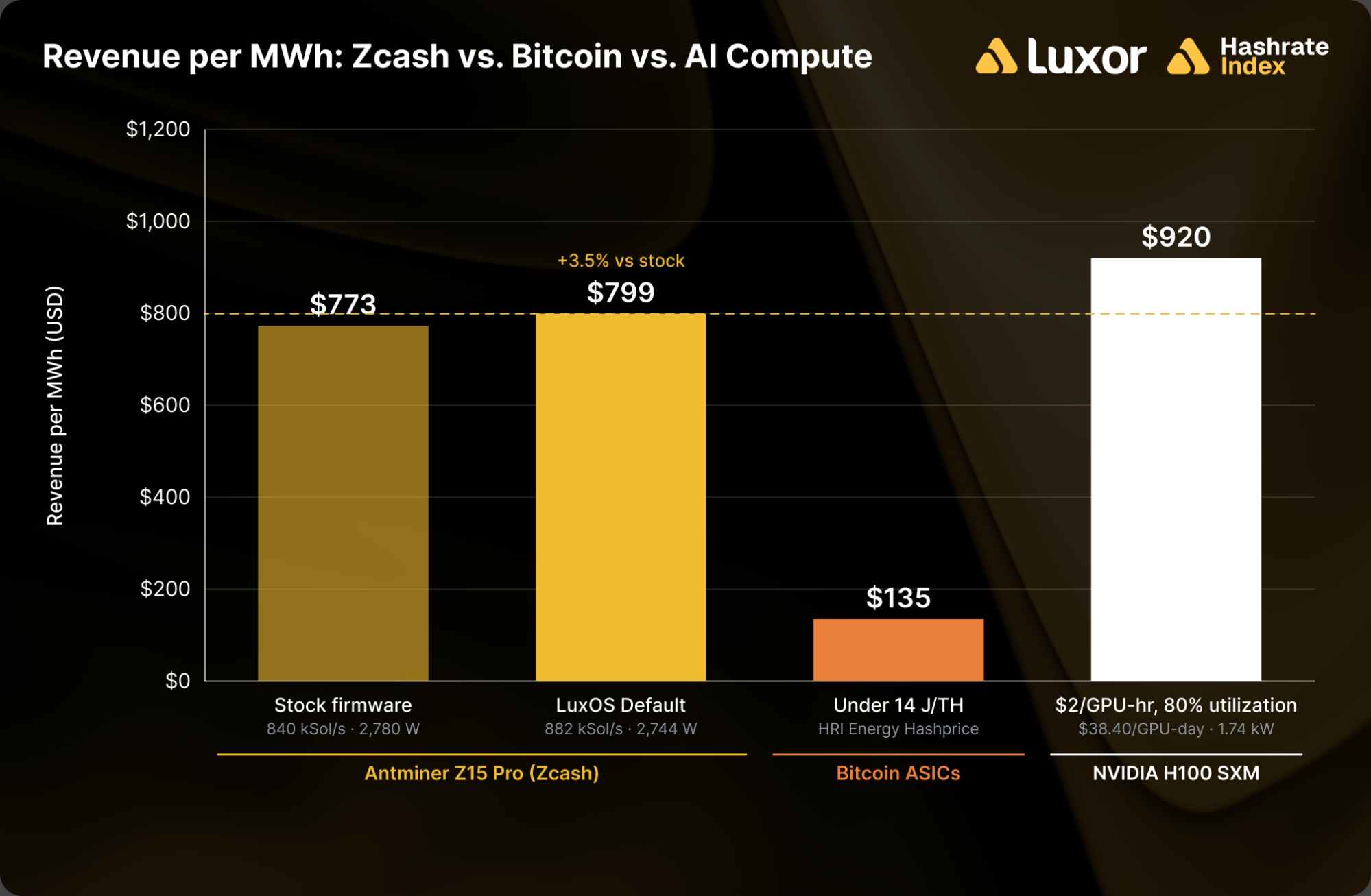
Analyzing these assets through the lens of revenue generated per megawatt-hour (MWh) reveals a complex hierarchy where no single technology wins every category. When evaluated at a standard industrial power cost of $0.08 per kilowatt-hour, an Antminer Z15 Pro mining Zcash pulls in roughly $770 of revenue per megawatt-hour. Meanwhile, top-tier Bitcoin ASICs lag significantly behind at approximately $135 per MWh under current hashprice conditions. Sitting at the top of the raw revenue metric is the rented NVIDIA H100 GPU, which generates about $1,680 per MWh—provided it remains continuously utilized.
Yet, looking solely at top-line revenue per unit of energy tells only part of the story. The true competitive landscape of modern compute is defined by a delicate balance between energy efficiency, rental utilization rates, and initial capital expenditures.
Three Machines, One Megawatt
To accurately evaluate how these machines stack up against one another, analysts must standardize their inputs around energy consumption. Using metrics captured in mid-October 2026, with Zcash trading at $1,185 and the broader network operating at a hashrate of 27.8 GSol/s, the financial mechanics of Equihash mining become starkly apparent.
Zcash miners collectively receive a fixed reward of 1,440 ZEC daily. Under these network conditions, a stock Antminer Z15 Pro grosses roughly $51.54 per day. After accounting for daily electricity costs of $5.34 at $0.08/kWh, the machine retains a net daily profit of $46.20. This equates to an extraordinary 90 percent profit margin and yields a power break-even threshold of $0.77/kWh—nearly ten times what the average industrial cryptocurrency miner typically pays for electricity.
In contrast, Bitcoin ASICs operate in a completely different financial reality. With Hashrate Index pegging the overall energy hashprice at $39.71 per petahash per day, fleets utilizing hardware under 14 J/TH generate roughly $135 per MWh, while newer Antminer S21-class hardware captures closer to $98 per MWh.
The wildcard in this equation is the NVIDIA H100. Based on recent OCPI-H100 cloud rental settlements of $2.92 per GPU-hour, a single H100 generates $70.08 daily. When factoring in comprehensive facility power consumption—calculated at 1.74 kW per GPU, which includes a power usage effectiveness (PUE) multiplier—the revenue scales to approximately $1,679 per MWh. This is more than double the energy output efficiency of a stock Z15 Pro. However, this dominance is entirely dependent on the GPU maintaining consistent rental demand. If utilization drops to 50 percent, the H100’s revenue generation falls to roughly $839 per MWh, placing it neck-and-neck with the Zcash ASIC.
Where the ASIC Wins: Capital, Not Energy
While AI accelerators hold a clear advantage in revenue per megawatt of power, the financial dynamics flip entirely when examining capital expenditure (capex). Building out a megawatt of compute using Zcash ASICs requires roughly 360 Antminer Z15 Pro units, priced between $8,800 and $16,000 per machine, housed within a basic warehouse infrastructure costing a few hundred thousand dollars per megawatt.
Conversely, deploying a megawatt of H100 accelerators requires roughly 575 individual GPUs. Given that new 8-GPU H100 nodes have commanded prices ranging from $31,000 to $40,500 per GPU since their market launch, the hardware alone represents an initial capital outlay of $18 million to $23 million, with refurbished units still running around $13 million. Furthermore, these GPUs must reside within a sophisticated Tier-3 data center facility, where the real estate and cooling infrastructure can easily cost more than the computing hardware itself.
By comparison, the Z15 Pro achieves full capital payback in roughly 6 to 11 months on its robust $46 daily gross profit. This stark disparity highlights the fundamental trade-off facing infrastructure operators: while AI hardware maximizes revenue per electron, ASIC mining maximizes capital efficiency and accelerates deployment velocity.
Lower cloud rental rates compress this margin even further. If GPU rental rates slip to $2.00 per hour at an 80 percent utilization rate, the H100 generates approximately $920 per MWh—only 15 percent higher than an optimized Z15 Pro running alternative firmware. Should utilization dip below 70 percent at those rental rates, the Zcash ASIC quietly surpasses the AI accelerator in revenue generation per megawatt-hour before even factoring in the massive capital savings.
Price Outruns Hashrate in the Zcash Ecosystem
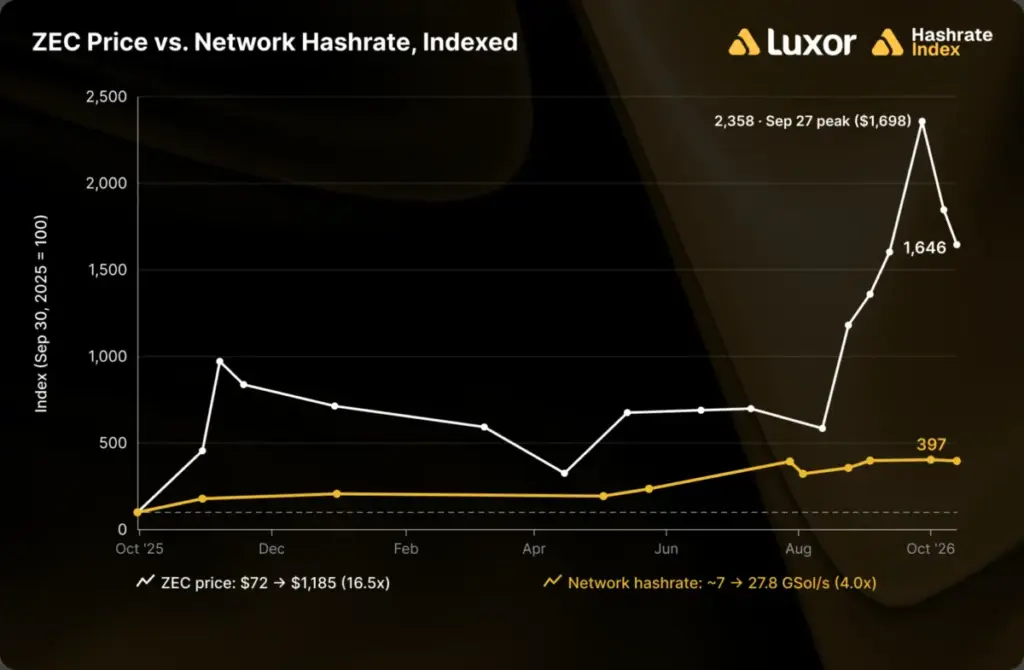
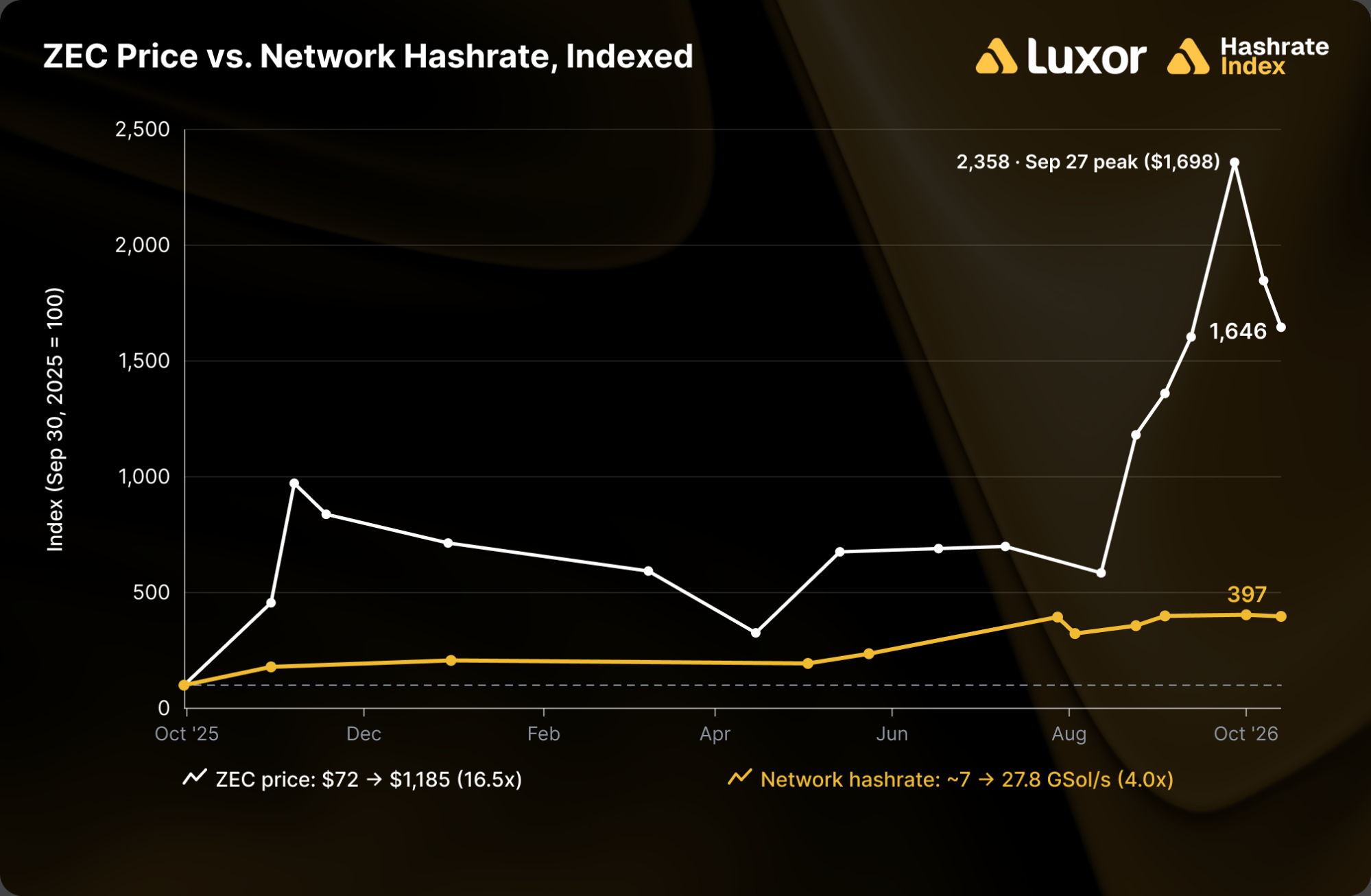
The dramatic profitability of Zcash mining over the past year is rooted in a fundamental market mismatch: token price appreciation vastly outpaced network hashrate growth. Over a twelve-month period, Zcash’s total network hashrate grew roughly fourfold, climbing from approximately 7 GSol/s prior to a major autumn rally to 27.8 GSol/s. During that same window, the price of ZEC surged from $72 to a peak of nearly $1,698 before retracing roughly 30 percent.
Because network hashrate lagged behind price momentum during both the explosive upside and subsequent market consolidations, per-machine revenue remained remarkably stable. The daily miner issuance remains rigidly fixed at 1,440 ZEC, meaning every new machine deployed dilutes the earnings of existing operators. The Zcash network now commands the equivalent of roughly 33,000 Z15 Pro units consuming 90 megawatts of power.
Yet, at prevailing market prices, the hardware remains exceptionally cash-positive, retaining profitability until the network hashrate expands by another factor of ten. The true bottleneck for Zcash miners is not electricity availability, but hardware supply. In-stock Z15 Pros have grown significantly scarcer, with secondary market prices multiplying several times over. With Bitmain’s next-generation Equihash ASIC hardware not anticipated until the second quarter of 2027—and major industrial players already securing priority allocations—operators are looking toward software optimization to squeeze additional performance out of existing fleets.
Firmware as the Primary Lever for New Hashrate
In the absence of new silicon deliveries ahead of 2027, data center operators are turning to advanced firmware solutions to boost Equihash hashrate from machines already deployed on site. Alternative firmware platforms, such as Luxor’s LuxOS, have introduced specialized tuning profiles for the Z15 Pro, granting miners the ability to overclock or underclock hardware in a manner similar to established Bitcoin mining operations.
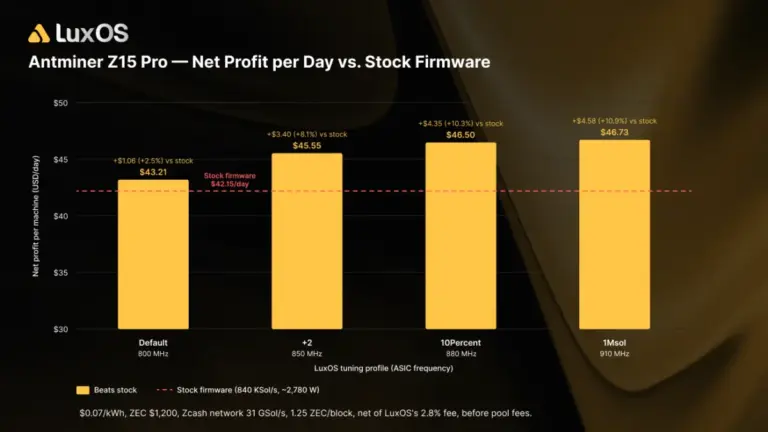
Benchmarking data reveals that while aggressive overclocking profiles trade energy efficiency for absolute token generation, moderate default tuning profiles can successfully increase hashrate by roughly 5 percent while simultaneously reducing power consumption by 1 percent. This optimization elevates the revenue potential to roughly $799 per MWh compared to the stock 773 benchmark.
However, pushing hardware to higher performance tiers increases power draw faster than hashrate gains, reducing efficiency. For facilities operating under strict power constraints or facing higher electricity tariffs, aggressive overclocking can prove counterproductive. Nonetheless, with network expansion constrained by physical hardware shortages, firmware tuning remains the most viable tool for operators seeking to maximize output from their existing megawatt footprints.
Ultimately, the compute competition is not a monolithic race. When measured strictly by megawatt-hours, a continuously rented AI accelerator outpaces a Zcash ASIC, which in turn vastly outperforms traditional Bitcoin mining hardware. When evaluated per dollar of deployed capital, however, ASICs secure a decisive victory through rapid payback periods. As infrastructure providers increasingly explore multi-use facilities capable of hosting both AI workloads and cryptocurrency mining under one roof, success belongs to those who minimize downtime and maintain high hardware utilization across all computing verticals.
 Cryptocurrency Mining
 Cryptocurrency Mining
 Cryptocurrency Mining