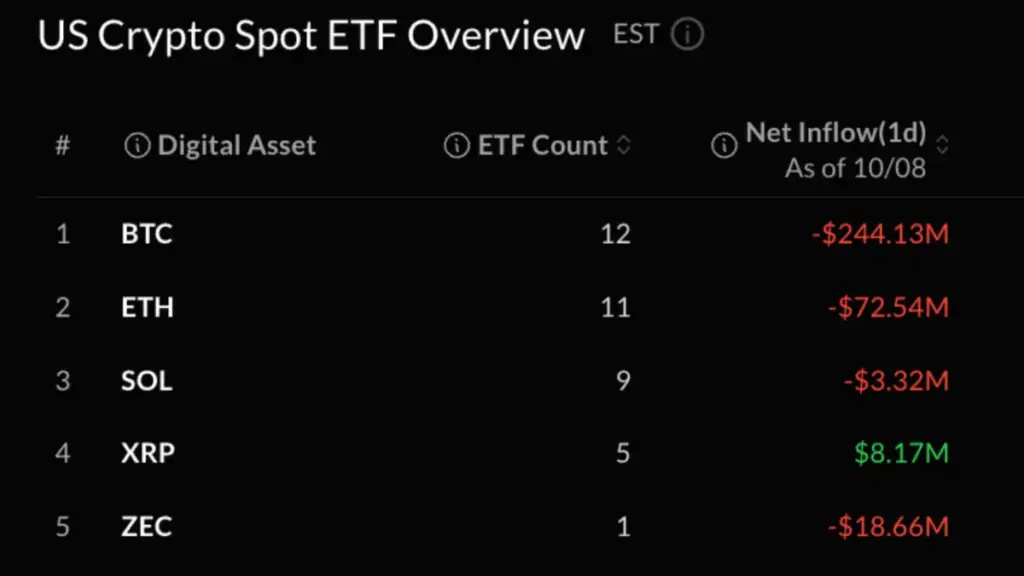
The institutional retreat from major digital asset investment products accelerated sharply on Thursday, dragging down both major cryptocurrencies and sending shockwaves through the broader market. United States spot bitcoin exchange-traded funds shed another $244.13 million, while ether-based investment vehicles lost $72.54 million, marking an eight-consecutive-day losing streak for the second-largest crypto category.
Combined outflows from the two dominant digital asset ETF classes have now reached roughly $965 million across just two trading sessions, according to recent market data. The sudden and aggressive capital flight underscores a rapidly shifting sentiment among institutional market participants, who appear to be actively de-risking their portfolios following a prolonged accumulation phase observed throughout September.
Bitcoin ETFs Lose $244M as Fidelity Sheds $197M
The selling pressure across spot bitcoin investment products intensified on Thursday, accompanied by a notable pickup in overall trading activity that signaled a concerted effort by institutional allocators to trim their exposure. Bitcoin exchange-traded funds followed up on a heavy withdrawal day earlier in the week with another $244.13 million exiting the ecosystem.
Fidelity’s FBTC bore the brunt of Thursday’s downward pressure, accounting for the vast majority of the selling with a substantial $197.09 million leaving the fund. Additional outflows were recorded across several other prominent issuers, including the Ark and 21Shares fund ARKB, which shed $20.29 million, Bitwise’s BITB, which lost $17.71 million, and Grayscale’s converted GBTC product, which recorded an $8.20 million exit.
Even BlackRock’s market-leading IBIT was not entirely immune to the sentiment shift, slipping by $5.54 million. Franklin Templeton’s EZBC stood out as the lone buyer among the major spot products during the session, managing to attract a modest $4.71 million in net inflows.
Despite the pervasive outflows, market activity remained brisk, with overall trading value jumping to $3.81 billion across the suite of funds, while aggregate net assets contracted to $104.91 million. This combination of heavier turnover and persistent daily redemptions points directly toward active institutional de-risking rather than passive market drift.
For the broader digital asset economy, the flow dynamics have experienced a swift reversal. After spending September building long positions, institutional market posture has turned defensive. Reflecting this broader macroeconomic and structural recalibration, the price of bitcoin retreated more than 4% over the course of a single week, recently slipping below the $82,800 threshold as market participants digest the sustained liquidity drain.
Ether’s Losing Streak Becomes Entrenched
While bitcoin products faced heavy liquidations, ether-based ETFs experienced an even more entrenched losing streak, posting $72.54 million in net withdrawals on Thursday to extend their consecutive streak of negative flows to eight trading sessions.
BlackRock’s ETHA once again absorbed the brunt of the market pressure, accounting for $71.12 million of the day’s total exits. Grayscale’s ETHE also contributed to the negative tally with a $6.12 million reduction, while smaller redemptions were noted across offerings from 21Shares’ TETH and VanEck’s ETHV.
A few products managed to buck the trend, though their inflows were negligible compared to the heavy outflows. Fidelity’s FETH attracted $5.50 million, and institutional heavyweight Morgan Stanley’s MSSE added $1.32 million. Trading activity across all ether funds climbed to $1.92 billion for the day, while total net assets dropped to $15.64 million.
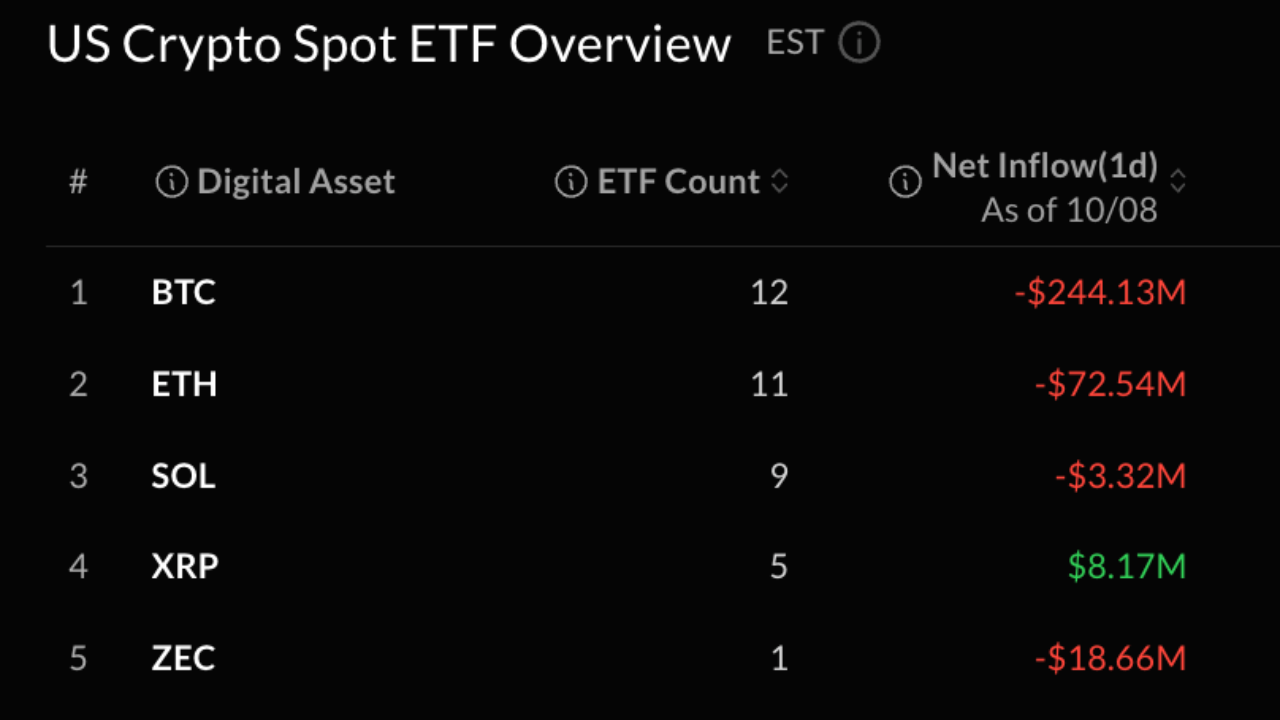
When combined with the heavy losses seen in bitcoin products, digital asset investment vehicles have now bled roughly $964.5 million over a punishing 48-hour window. The unprecedented speed of this capital reversal has made it increasingly difficult for market analysts to write off the figures as routine portfolio rebalancing or short-term market noise.
The underlying asset has felt the impact acutely. The price of ether has suffered a much sharper correction over the trailing seven days, plunging more than 9% to change hands near $2,485 as selling pressure compounds across both spot markets and derivatives.
XRP and NEAR Resist the Broader Retreat
Even as the dominant cryptocurrencies faced heavy institutional capital flight, pockets of resilience emerged further down the market capitalization spectrum, with select alternative digital asset funds capturing fresh inflows.
XRP exchange-traded products managed to attract $8.17 million on Thursday, driven entirely by activity in Franklin Templeton’s XRPZ fund. Trading volume for the product reached $65.44 million, helping to stabilize net assets at $1.56 billion.
Similarly, Bitwise’s NEAR ETF, trading under the ticker NRR and launched just last week, added $4.04 million on Thursday. The newly introduced product closed the session with $5.986 million in net assets, representing approximately 1% of the total market capitalization of the underlying token. These localized inflows stand in stark contrast to the widespread capital withdrawals plaguing the broader digital asset ETF landscape.
Zcash, HYPE, and Solana Stay Under Pressure
Not all alternative assets escaped the broader market correction. Privacy-focused Zcash ETFs faced continued liquidations, shedding another $18.66 million exclusively through Grayscale’s ZCSH vehicle. This steady outflow pushed the fund’s net assets below the $700 million mark to close at $655.95 million, though cumulative net inflows since inception remain comfortably positive at $181.84 million.
Meanwhile, HYPE exchange-traded products shed $9.70 million through 21Shares’ THYP offering. Solana investment funds also extended their recent struggles, posting a fourth consecutive day of negative flows with a $3.32 million withdrawal. Bitwise’s BSOL accounted for $5.26 million of the exits, though smaller offsetting inflows into products managed by Morgan Stanley’s MSOL and Invesco’s QSOL softened the net blow.
Globally, the regulatory and investment infrastructure surrounding crypto ETFs continues to evolve despite the immediate market turbulence. Thailand’s Securities and Exchange Commission recently issued formalized regulations permitting locally listed crypto exchange-traded funds—initially focusing on bitcoin and ether—with the newly minted legal framework officially taking effect on October 16.
For U.S. markets, however, the immediate signals emanating from institutional trading desks remain decidedly defensive. The combination of elevated trading volumes and nearly $1 billion in combined bitcoin and ether redemptions over a two-day span demonstrates that institutional players are actively slashing their exposure rather than simply sitting on the sidelines waiting for a market bottom.
 Bitcoin & Major Altcoins
 Bitcoin & Major Altcoins
 Bitcoin & Major Altcoins