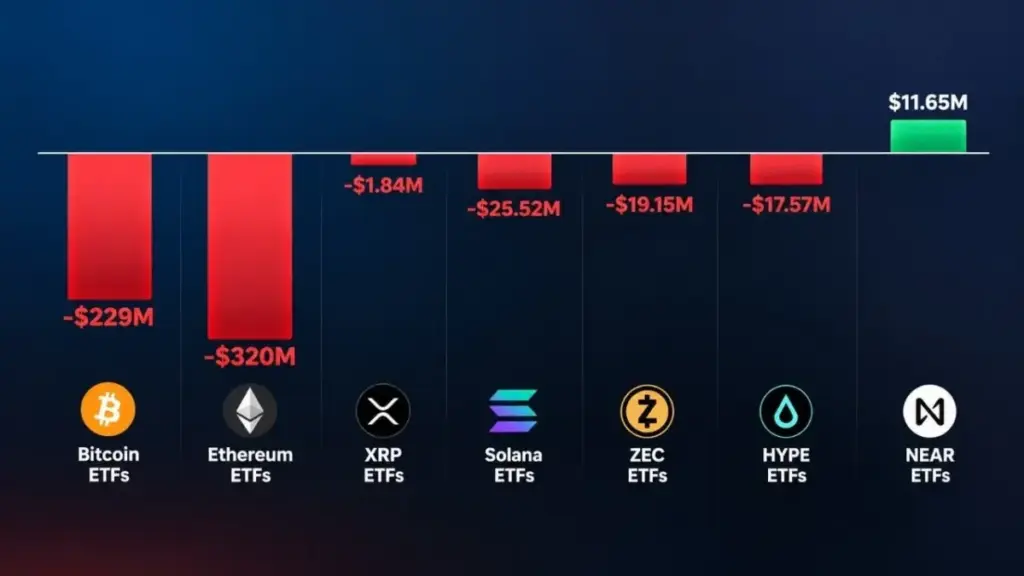
U.S. cryptocurrency exchange-traded funds remained under sustained pressure in the week through October 16, extending a broad retreat as institutional investors aggressively reduced their exposure to digital assets. While the absolute pace of capital withdrawals eased compared to the prior week’s steep sell-off, selling pressure remained generalized across nearly every major digital asset category, underscoring a cautious and defensive posture among institutional participants navigating a complex macroeconomic backdrop.
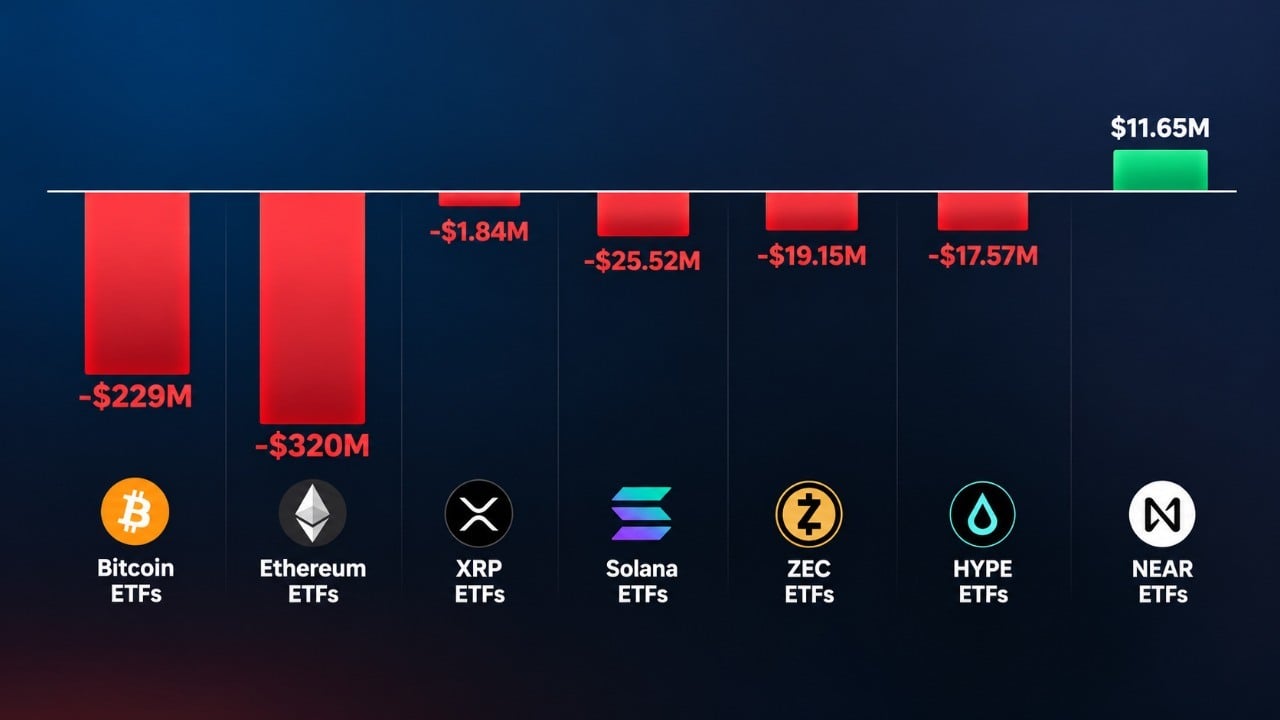
Data from the week showed that institutional investors pulled roughly $593 million from the five major crypto ETF categories combined. Although this represented a roughly 52% reduction in withdrawal intensity compared to the staggering $1.2 billion that left these funds during the previous week, the underlying sentiment remained firmly risk-off. Every single major category finished the weekly trading period in negative territory, proving that while the bleeding slowed, confidence had not yet returned to the market.
Bitcoin exchange-traded funds bore the largest absolute dollar loss, shedding about $228.6 million between Monday and Friday. This followed a turbulent period that included a massive $681 million withdrawal a week earlier. The path of bitcoin funds over the five-day trading window was characterized by sharp, volatile swings rather than a steady exodus. The week opened on a down note with a $65.40 million exit on Monday, before a brief flicker of institutional optimism drove a $175.62 million rebound on Tuesday.
That bullish momentum evaporated almost overnight. On Wednesday, the funds suffered a severe setback as $261.46 million left the ecosystem. Thursday offered a negligible reprieve with a marginal $5.06 million in net inflows, but the week concluded with a renewed $82.39 million exit on Friday. Individual fund flows highlighted concentration among major issuers, with BlackRock’s IBIT accounting for $165.4 million of the weekly redemptions, while Fidelity’s FBTC lost $60.2 million. In contrast, Morgan Stanley’s MSBT managed to buck the broader trend within the bitcoin category, attracting $6.7 million in net inflows.
Despite the heavy dollar amounts leaving bitcoin products, the relative scale of the withdrawals tells a more nuanced story about where the pressure was felt most acutely. Bitcoin ETF assets finished the week standing at a massive $104.29 billion. Consequently, the weekly outflows represented only about 0.22% of that total asset base, demonstrating that long-term institutional holders in the flagship cryptocurrency product category were largely holding their ground rather than panic-selling.
Ethereum Carries the Heavier Burden
In contrast, the market dynamics surrounding ether ETFs painted a far more vulnerable picture. Ether-backed products closed the week with $104.29 billion in assets for bitcoin, while ether funds held roughly $14.95 billion after shedding about $320 million. That weekly outflow was equivalent to roughly 2.14% of ether’s total assets under management. Measured relative to fund size, ether faced close to 10 times the redemption pressure experienced by bitcoin over the same timeframe.
Furthermore, the redemptions cemented a grim milestone for ether products, which recorded their third consecutive negative week. A brief moment of relief occurred on Tuesday when a $24.84 million inflow momentarily interrupted what had been a persistent 10-day losing streak. However, the reprieve proved short-lived. Ether funds plunged back into the red with a $129.51 million loss on Wednesday, followed by $60.22 million on Thursday, and another $69.68 million on Friday.
Trading activity across the board cooled concurrently with the persistent redemptions. Bitcoin ETF turnover declined over the course of the week to about $10.11 billion, down from $11.44 billion the week prior. Meanwhile, ether trading volume experienced an even steeper contraction, falling roughly 34% to $3.44 billion. Market analysts noted that the combination of lower trading turnover and continuous net redemptions points to a broader cooling of institutional enthusiasm, with capital sidelined as participants reevaluate their strategies.
Solana and Alternative Assets Face Deepening Institutional Retreat
Beyond the two largest digital assets, alternative cryptocurrency ETFs faced intensifying structural headwinds, with Solana products providing a particularly notable warning signal. Solana-linked funds lost $25.52 million during the week, slightly exceeding the previous week’s record $24.81 million outflow. These consecutive weeks of heavy redemptions pushed two-week withdrawals for Solana products to approximately $50.33 million.
Solana products recorded 10 consecutive trading days of net outflows over the period, causing total ETF assets in the category to slide to $1.62 billion. Weekly redemptions accounted for roughly 1.58% of assets under management, while the underlying SOL token declined by about 4.6% over the course of the week. This downward trajectory marks a dramatic reversal for a category that had previously enjoyed an impressive 14-week streak of uninterrupted institutional inflows.
Other alternative asset products also faced downward pressure. XRP ETFs lost a relatively modest $1.84 million, while HYPE products recorded $17.57 million in weekly redemptions. Zcash funds shed $19.15 million as the initial post-launch enthusiasm and speculative trading interest continued to fade from the market.
NEAR Remains the Exception
Amid the pervasive risk reduction and widespread liquidations, NEAR-backed products once again moved against the prevailing current. Bitwise’s NRR fund successfully attracted $11.65 million during the week, recording positive inflows on Monday, Tuesday, Thursday, and Friday. It stands out as one of the few newer product offerings capable of drawing consistent capital commitments while the broader digital asset market contends with macro-driven capital flight.
The overarching macroeconomic environment goes a long way toward explaining the defensive positioning adopted by institutional allocators. Inflationary pressures in the United States have refused to recede as quickly as some investors had hoped. Recent government data showed that the September Consumer Price Index accelerated to an annual rate of 3.7%, while producer prices rose by a substantial 6.3%. Escalating energy costs compounded these pressures, strengthening the economic argument for the Federal Reserve to maintain a restrictive, higher-for-longer monetary policy stance.
This resilient inflationary backdrop and the prospect of sustained high interest rates have cast a heavy shadow over bitcoin and the wider spectrum of risk assets, driving institutional portfolios toward safer havens. While the slowdown in the velocity of ETF withdrawals offers a tentative glimmer of hope that the worst of the immediate selling wave may be moderating, market participants remain skeptical. The critical question facing the market is whether this fragile stabilization can withstand upcoming economic data releases and potential further rounds of rate repricing by central bankers. For the time being, institutional capital remains engaged in the digital asset ecosystem, but it is increasingly defensive, highly selective, and unwilling to chase momentum in an uncertain climate.
 Bitcoin & Major Altcoins
 Bitcoin & Major Altcoins
 Bitcoin & Major Altcoins