Six years after preparing for one of its most defining expansions against Bitcoin, the Ethereum network and its native token are once again approaching a historical juncture that could reshape the broader digital asset landscape. Market participants and on-chain analysts are increasingly looking back at pivotal moments in crypto history to contextualize the current price action of the ETH/BTC trading pair, drawing striking parallels between the market structure of late 2020 and the unfolding dynamics heading toward 2026.
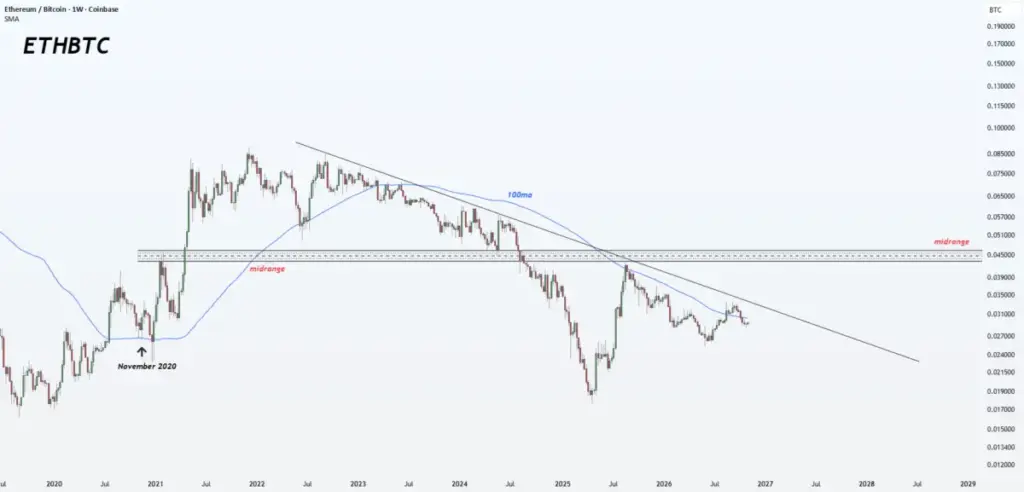
Back in November 2020, the ETH/BTC pair was actively recovering from an extended period of relative weakness and stagnation. During that period, the critical 0.045 region emerged as a vital technical barrier. Once Ethereum managed to clear and sustain itself above this threshold, it eventually entered a powerful and sustained period of relative outperformance against the pioneer cryptocurrency. What followed next was widely regarded by market historians as one of the most significant and consequential capital rotations in the history of the cryptocurrency market, setting off a massive altcoin expansion cycle that altered portfolio allocations worldwide.
Now, as the market navigates the landscape toward 2026, the macro setup presents a dramatically different visual narrative on the charts, yet one that carries a familiar sense of anticipation. For several years, Ethereum has steadily lost ground against Bitcoin, resulting in a persistent macro downtrend. A descending resistance line originating all the way back in 2022 continues to define the broader trend structure, keeping downward pressure on the asset pair. Currently, the ETH/BTC ratio is trading near the 0.030 level, hovering right around its 100-week moving average (SMA). Lurking above this current consolidation zone is the historical 0.044 to 0.046 midrange, representing the ultimate structural hurdle for the altcoin leader.

For the market to shift its current paradigm, analysts note that a specific sequence of technical events must unfold. The immediate challenge facing Ethereum is the successful reclamation and breakout above the multi-year descending trendline that has dictated price action since the highs of 2022. However, conquering the trendline is merely the first step in a larger recovery process. The real prize, and the definitive confirmation of a shifting market cycle, lies in breaking through the historical midrange between 0.044 and 0.046. Until those structural milestones are convincingly cleared, the broader multi-year downtrend technically remains intact, leaving market participants in a state of watchful waiting.
Beyond the raw technical indicators and moving averages, there is a profound psychological dimension to the current market environment that is worth remembering. After enduring years of relative underperformance and watching Bitcoin capture the lion’s share of institutional inflows and market attention, investors have naturally grown accustomed to Ethereum functioning as the weaker asset in the pair. Over extended periods of sideways or downward momentum, market expectations inevitably adjust downward. Patience among retail and institutional holders alike has largely evaporated, and the very idea of another major ETH/BTC structural expansion sounds increasingly unrealistic to a fatigued audience.
Yet, seasoned market observers and cycle researchers emphasize that major capital rotations rarely announce themselves when everyone is expecting them to happen. Typically, sentiment bottoms out precisely when prevailing pessimism reaches its peak and participants are least inclined to believe in a turnaround. Despite the persistent headwinds and the length of the ongoing correction, long-term market theses focusing on structural cycles remain bullish on the potential for a reversal. Analysts following market fractals and macro liquidity flows argue that ETH/BTC is steadily approaching a potentially decisive turning point, even though the definitive breakout still needs to be firmly established on the charts.
For years, Bitcoin has undisputedly dominated the broader crypto conversation, capturing headlines through exchange-traded fund approvals, corporate treasury allocations, and macro narrative adoption. However, as cyclical patterns tend to repeat themselves through changing market phases, the next chapter of the digital asset economy may well belong to Ethereum should historical rotation patterns repeat. Whether the upcoming macro decision point will mirror the explosive outperformance seen in the wake of the 2020 consolidation remains to be seen, but the converging technical indicators suggest that the market is rapidly nearing a moment of truth.
 Crypto Investing & Trading
 Crypto Investing & Trading
 Crypto Investing & Trading